



A home yoga practice is shaped by more than the poses you practice. The materials beneath your hands, the props that support your movement, and the way your equipment fits into your home all influence how easily you return to your routine.
Building a thoughtful practice space does not mean replacing everything you own overnight. It means understanding what you bring into your home, choosing pieces designed to last, and creating an environment that supports the habits you want to maintain.
The Mache Approach: Designing a Yoga Space That Supports Your Practice
At Mache, wellness design starts with the idea that our surroundings shape how we live. A yoga space does not need to be large or perfectly styled. It simply needs to make your practice easier to begin and easier to return to.
That is why this setup combines the tools you use during practice with the storage solutions that help keep them part of your everyday environment.
Choose a Yoga Mat Made With Transparent Materials
Your yoga mat is one of the most-used pieces in your home practice. Since your mat is one of the most frequently used pieces in your practice, understanding its materials can help you make a more informed choice.
The challenge is that material labels do not always tell the whole story. Terms like “eco-friendly,” “green,” or even references to natural materials can describe part of a product without explaining the complete construction. If you are looking for a sustainable yoga mat, look beyond the front of the packaging and check whether the manufacturer clearly identifies the materials used.
Yoga Mat Materials: What to Know Before Buying
Natural rubber is a good option if you want a mat made from natural materials and want grip and durability. Cork offers a different texture and a firmer feel. PVC is also widely used, so if you are considering a PVC mat, look for manufacturers that clearly identify the material and formulation.
A quick comparison can help:
|
Material |
Benefits |
Feel |
Considerations |
|
Natural rubber |
Grip, durability, cushioning |
Cushioned and responsive |
Avoid if you have latex sensitivity |
|
Cork |
Good, especially with moisture |
Firm and natural |
May feel different from traditional mats |
|
PVC |
Varies by construction |
Can range from soft to firm |
Look for clear information about formulation and additives |
The simplest rule is to read beyond the headline claim. If a product page highlights sustainability but does not clearly explain what the mat is made from, look for more detailed material information.
Why This Matters More in a Small Room Than a Big Studio
Your home is not a ventilated commercial space. It's sealed, heated, and you're in it constantly. EPA research backs this up. Their Total Exposure Assessment Methodology study found levels of about a dozen common organic pollutants running 2 to 5 times higher inside homes than outside, whether the homes were rural or in industrial areas. And elevated concentrations can linger long after you've finished whatever released them. Now add a warm body, sixty minutes of skin contact, and sweat.
Here's the bottom line: the mat is the single highest-contact object in your practice. It earns the most scrutiny. If you want the full chemistry breakdown, we wrote one: Non-Toxic Yoga Mat: The Chemicals to Avoid and What to Buy Instead.
Piece 1: Choose a Yoga Mat Made With Transparent Materials

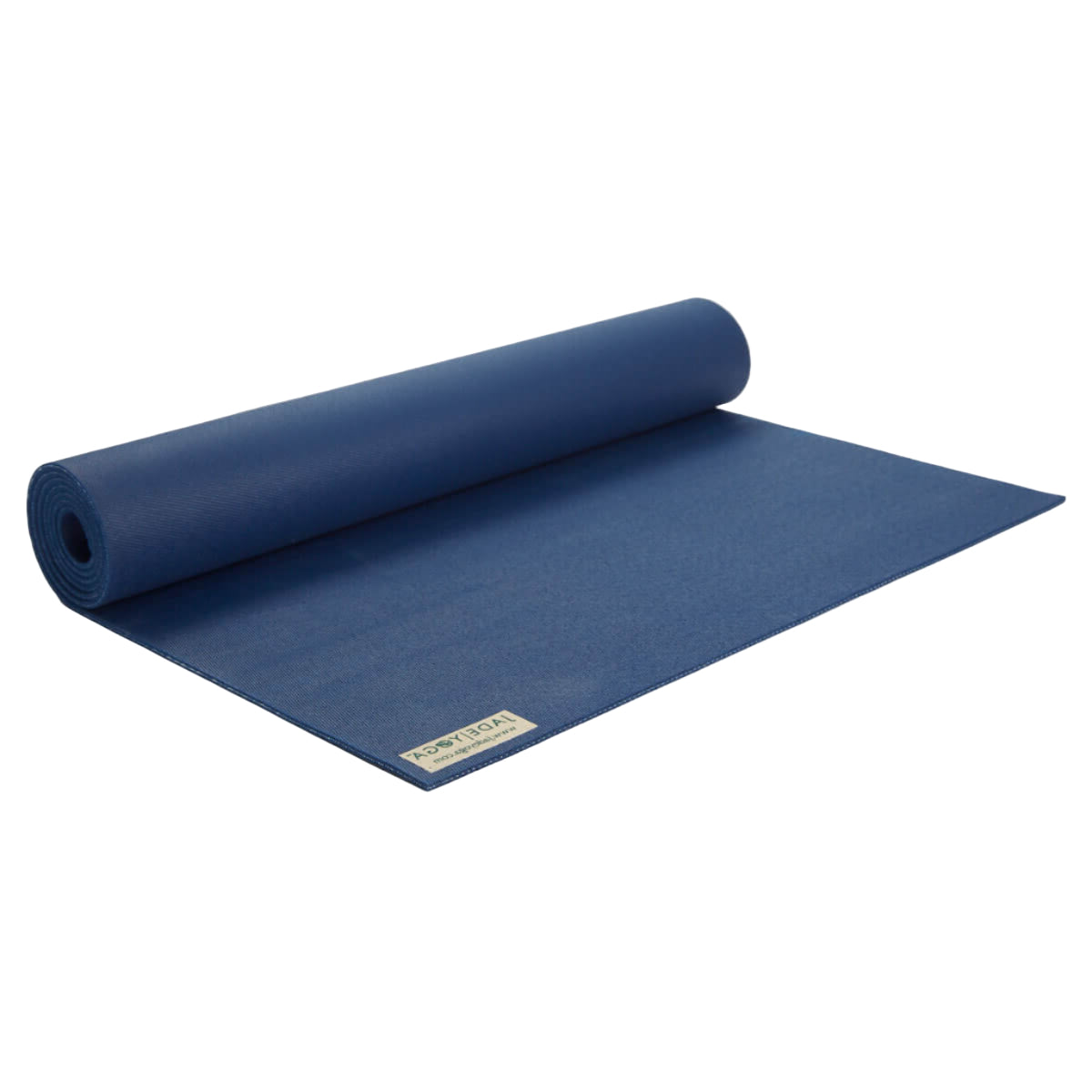
Rubber grips without coatings. That's the whole argument. PVC needs plasticizers to stay flexible; rubber is flexible because it's rubber. The Bean Products OMphibian is a natural rubber core with a wet-grip PU surface, and it's the mat I point people toward most often.
Specs worth knowing:
- 1/4 inch thick, dense enough to protect knees and elbows
- 26" x 72", wider and longer than a standard mat, which matters more than people expect
- Double-sided non-slip; holds grip wet or dry
- Alignment lines are laser-etched, not printed with ink
- $79.95
That laser-etching detail is small, and it tells you a lot. Most mats print alignment lines. Printing means pigment, and pigment means one more undisclosed additive sitting under your palms.
The Honest Caveat on Rubber
Natural rubber comes from Hevea brasiliensis sap, and some people react to it. Reported prevalence in the general population sits around 4.3%, with much higher rates among healthcare workers and people with repeated surgical exposure.
If you're in that group, rubber is off the table. There's no workaround. Look at cotton or cork-surface mats instead, and read the material breakdown before you buy. Quick sanity check before you order any mat: if the product page won't name the material, the material is the answer.
Piece 2: Add Cork Yoga Blocks for Support and Stability

Cork blocks provide a firm surface that supports balance, alignment, and modifications across different poses. That's not a comfort problem. That's an alignment problem.
Cork doesn't do that. It's dense; it holds its shape under load, and the surface texture actually improves with a little moisture.

Bean Products Cork comes in two sizes, and picking the right one is mostly about hand span:
|
Size |
Dimensions |
Best for |
Price (2-pack) |
|
Standard |
9" x 6" x 3" |
Smaller hands, travel, tighter storage |
$29.99 |
|
Large |
9" x 6" x 4" |
Average to large hands, more surface to grip |
$39.99 |
Buy two. One block is a compromise; two blocks unlock supported bridge, seated forward folds with real support, and every reclined shape where you need symmetry.
What "Non-Toxic Block" Actually Means Here

Cork is bark. It's harvested without felling the tree; it regrows, and it doesn't need a binder to hold a shape, which is exactly where foam blocks get complicated.
The beveled edges matter too. They're not a styling choice; they let you grip a block at an angle without your fingers sliding off in Triangle.
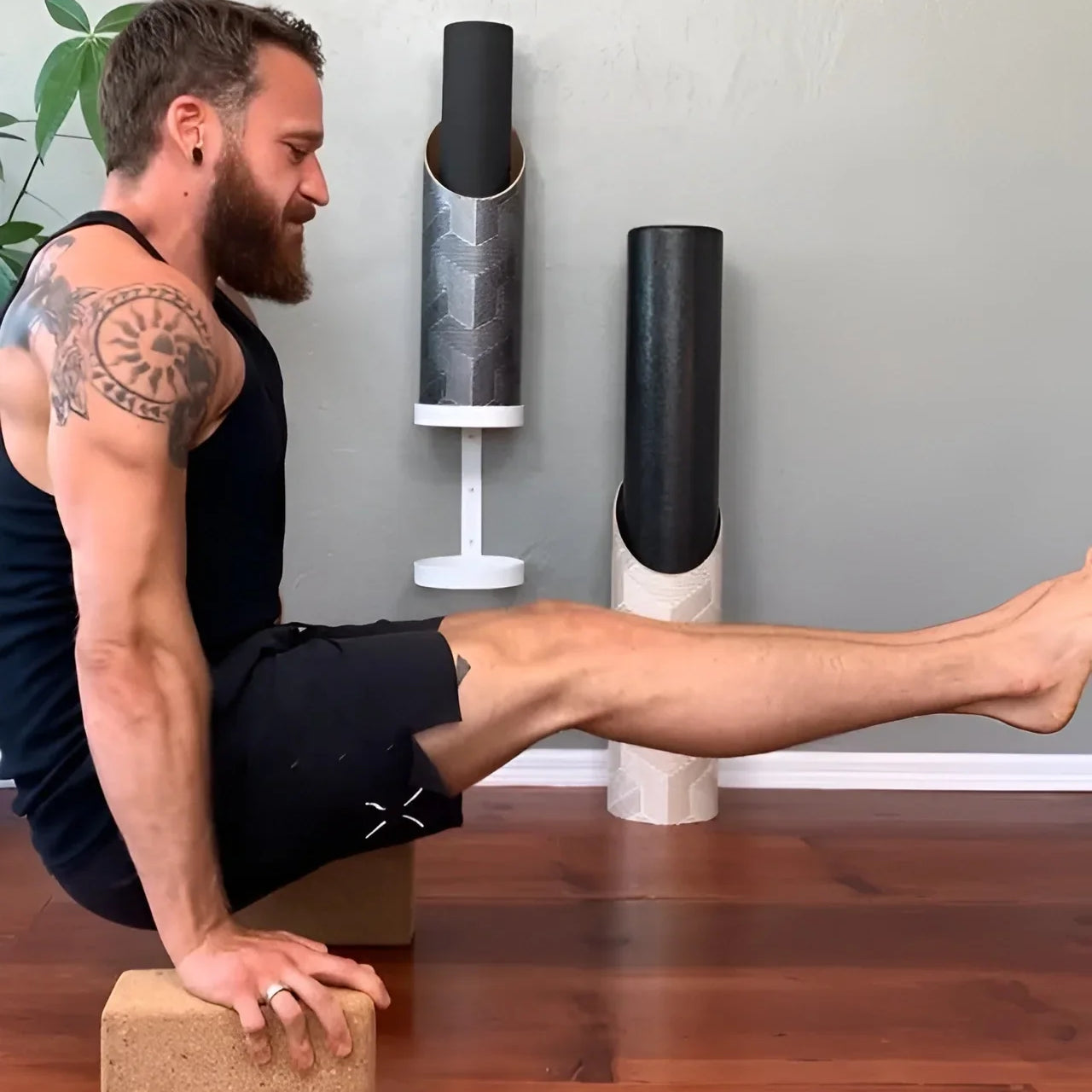
Most people improvise badly when storing two blocks. We built tube block storage and wall brackets precisely because blocks are the prop most likely to end up under a couch.
Piece 3: Use a Yoga Strap to Support Flexibility and Alignment

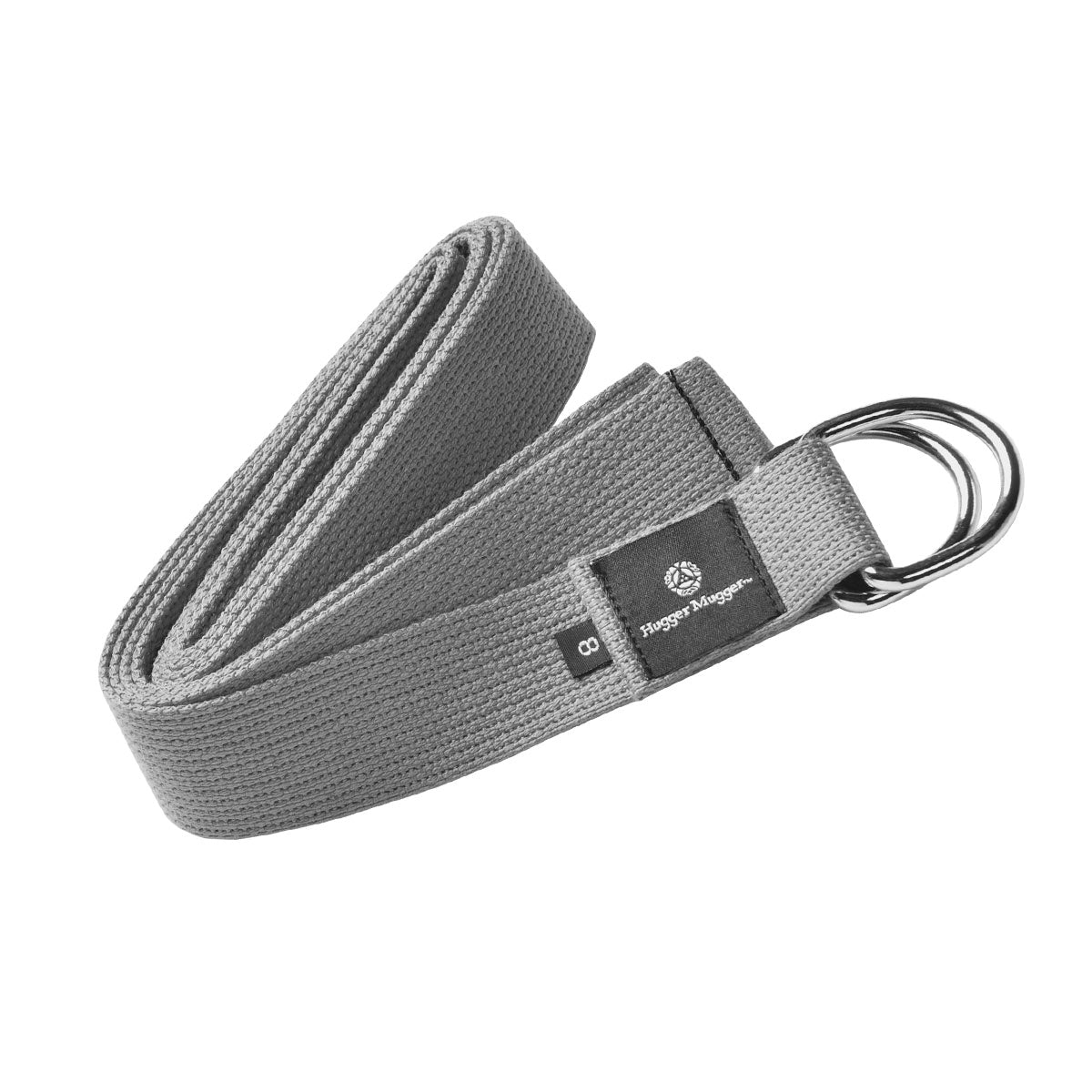
The yoga strap is the cheapest piece here, and the one beginners skip. A strap can make certain movements more accessible by extending your reach and creating a steadier connection in stretches.
The Bean Products hemp sling does double duty: it carries your rolled mat, and it becomes a stretching strap the second you unroll. Hemp webbing, no buckles, no Velcro to wear out.
$24.95.
Where a strap earns its keep:
- Reclined hamstring stretch without yanking your low back off the floor
- Shoulder openers when your hands won't meet behind you
- Seated forward fold with a flat spine instead of a rounded one
- Bound poses, months before your body would get there unassisted
- Carrying the mat, which also lets it air out on the walk home
No buckle is a real design decision, by the way. Buckles are the first failure point on most straps, and they're usually plastic. A loop can't break.
One Strap, Seven Poses
If you've never used one and aren't sure where to start, we put together a walkthrough: How to Use a Yoga Strap: 7 Poses for Beginners and Advanced Practitioners.
As a simple piece of sustainable yoga gear, a strap can become one of the most versatile tools in your practice. Read the guide once, keep the strap visible, and you'll be more likely to use it. Keep it in a drawer, and you might forget it exists. More on that in a minute.
Piece 4: Create Space for Rest With an Organic Cotton Yoga Bolster
This is the piece people cut to save money, and it's the one I'd argue is hardest to keep. A bolster makes a twenty-minute, slower, more supported practice possible on a day when a full flow isn't.
The Bean Products’ organic cotton bolster is extra-firm, handmade in the USA, and built with a foam core wrapped in tight cotton batting inside a cotton muslin case. $119.95, commercial grade, 1-year warranty.

Three shapes, three jobs:
|
Shape |
Dimensions |
What it's for |
|
Rectangle |
25" L x 12" W x 6" H |
Legs, back support, supported child's pose |
|
Round |
27" L x 9" diameter |
Chest opening, heart-forward reclining shapes |
|
Pranayama |
28" L x 6" W x 7" H |
Lengthwise spine support for breathwork |
If you're buying one: go with a rectangle. It's the most versatile shape and the one you'll reach for on a Tuesday night when you don't want to think.
"Extra-Firm" Is the Spec That Matters
A bolster that sinks isn't supporting you. It's just a pillow. Firmness is what lets your body stop bracing, which is the entire physiological point of restorative work.
Covers come off and wash in organic cotton or hemp. That's a fifteen-year product, not a two-year one.
Piece 5: Sustainable Storage to Keep Your Yoga Props Safe, Clean, and Easily Reachable
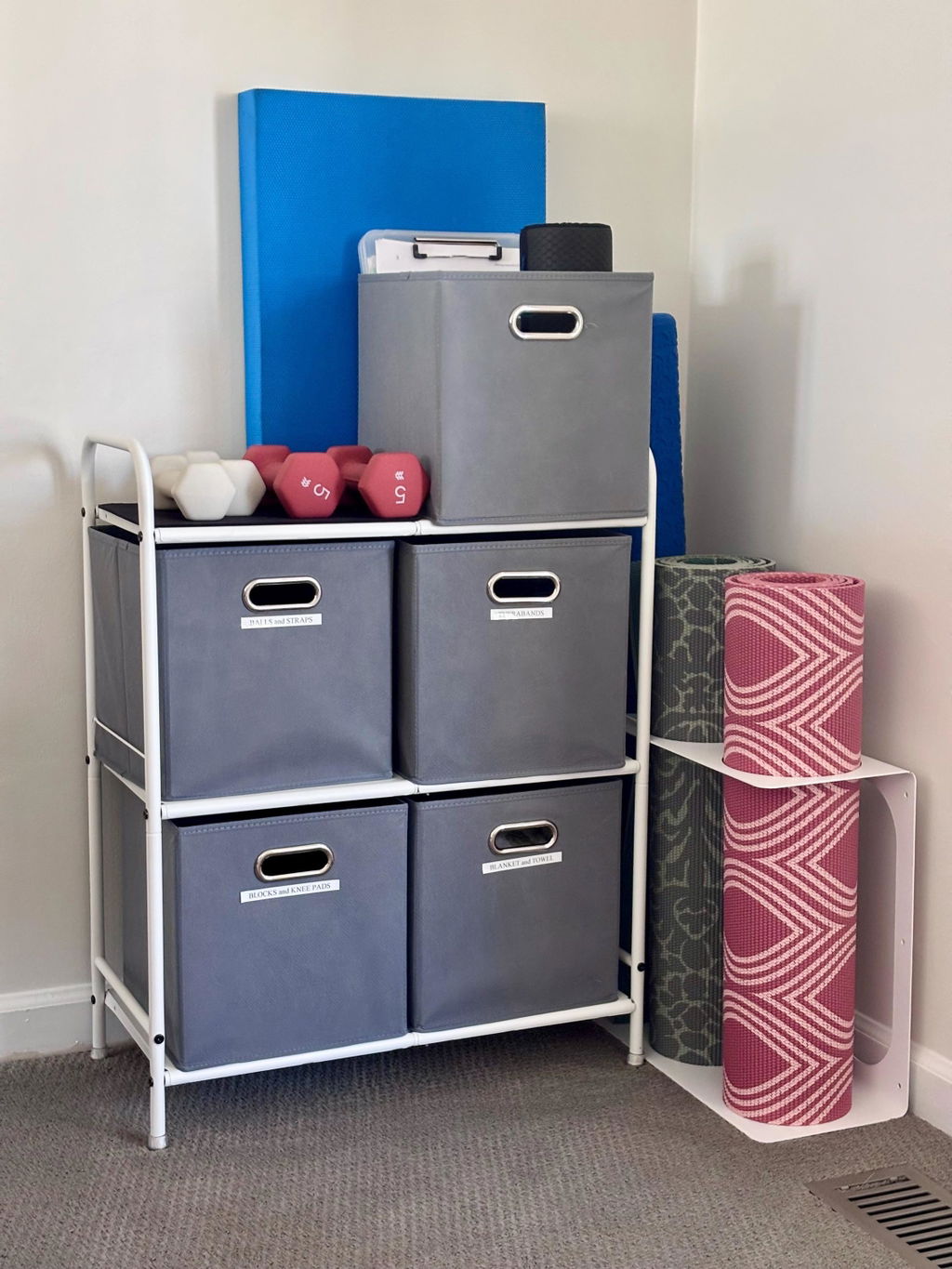
You can own the cleanest props on the market. If they live in a closet behind a vacuum, you will not practice. I've watched it happen in hundreds of homes.


Exercise Habits Are Genuinely Harder to Build. The Research Says So.
Phillippa Lally's team at UCL tracked 96 people as they formed new daily habits. On average, it took 66 days to reach automaticity.
But the key finding is this: Participants building an exercise habit took roughly 1.5 times longer than those building a simple eating habit. More complex behavior, more repetitions to automate. Which means every extra step between you and your mat costs you real days.
Do the math on friction. Fifteen seconds of digging in a closet, every session, across an 80-day runway. That's not a storage inconvenience. That's the reason your practice quietly stops.
Clutter Isn't Just Ugly. It Correlates With Your Stress Profile.
Saxbe and Repetti's 2010 study in Personality and Social Psychology Bulletin analyzed how 60 dual-income spouses described their homes on self-guided video tours. Women whose descriptions scored higher on "stressful home" language, meaning clutter and unfinished projects, showed flatter diurnal cortisol slopes, a pattern linked to worse health outcomes, plus increased depressed mood across the day. Those with more "restorative home" language showed the opposite.

Fair caveat: that's correlational, not proof that clutter causes anything. But it lines up with something I hear constantly from clients, in their own words: "I hate having my exercise equipment scattered all over the house, and yet I want it accessible for exercise 'snacks'." Vesta, Mache customer
That tension is the entire design problem: hidden means unused, scattered means stressful.
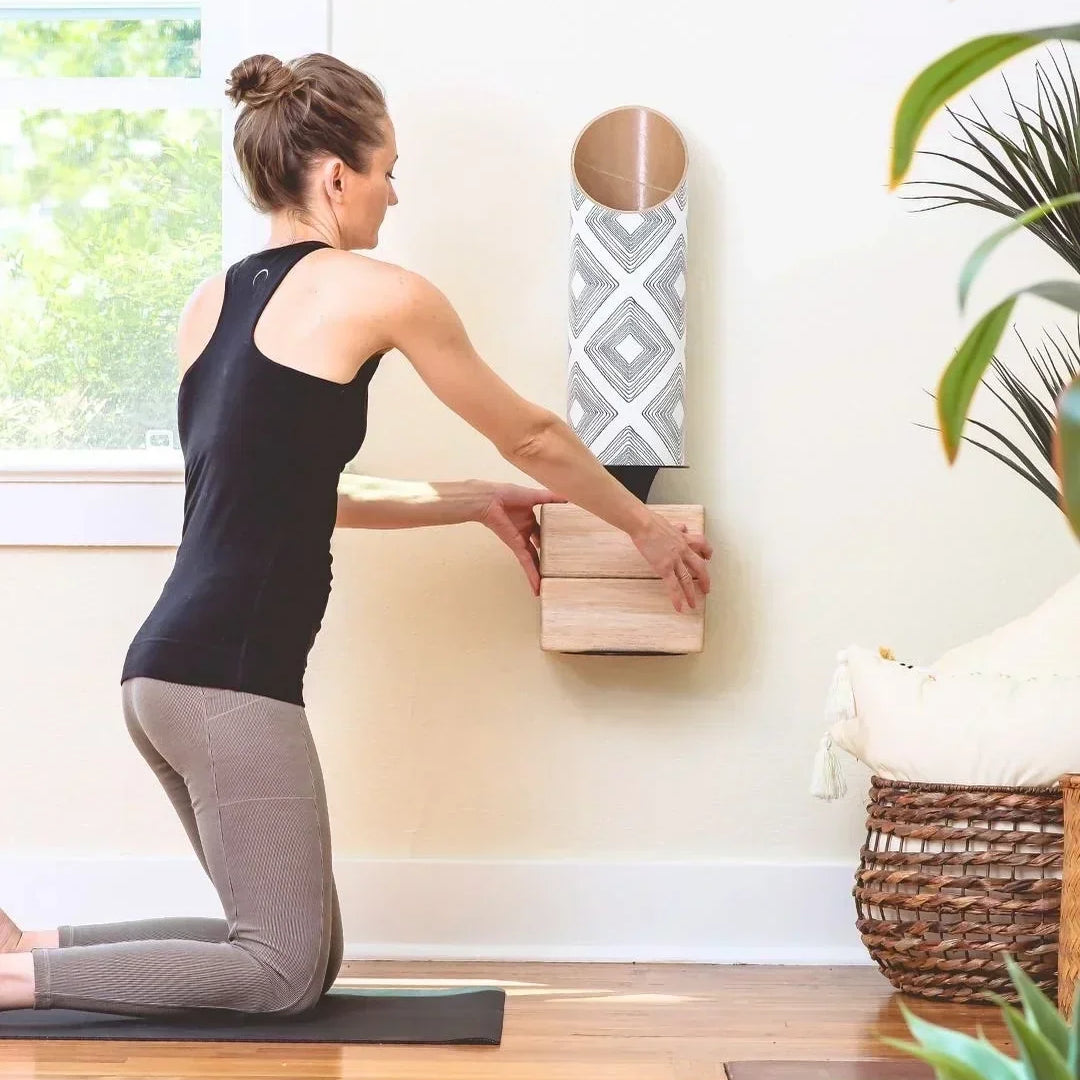
You need a third option: storage that works with your home's interior while keeping your yoga props clean, organized, and easy to reach whenever you want to practice.
Choose Storage Materials That Match Your Practice Values

Most people's logic has a gap here, and it's worth naming. You research your mat for a week. Then you set it in a particleboard cubby held together with urea-formaldehyde adhesive, in a sealed room, where it sits 23 hours a day.
A practice space isn't defined only by what you use during yoga. It is also shaped by what happens between sessions. Thoughtful and sustainable storage keeps your tools accessible without adding clutter.
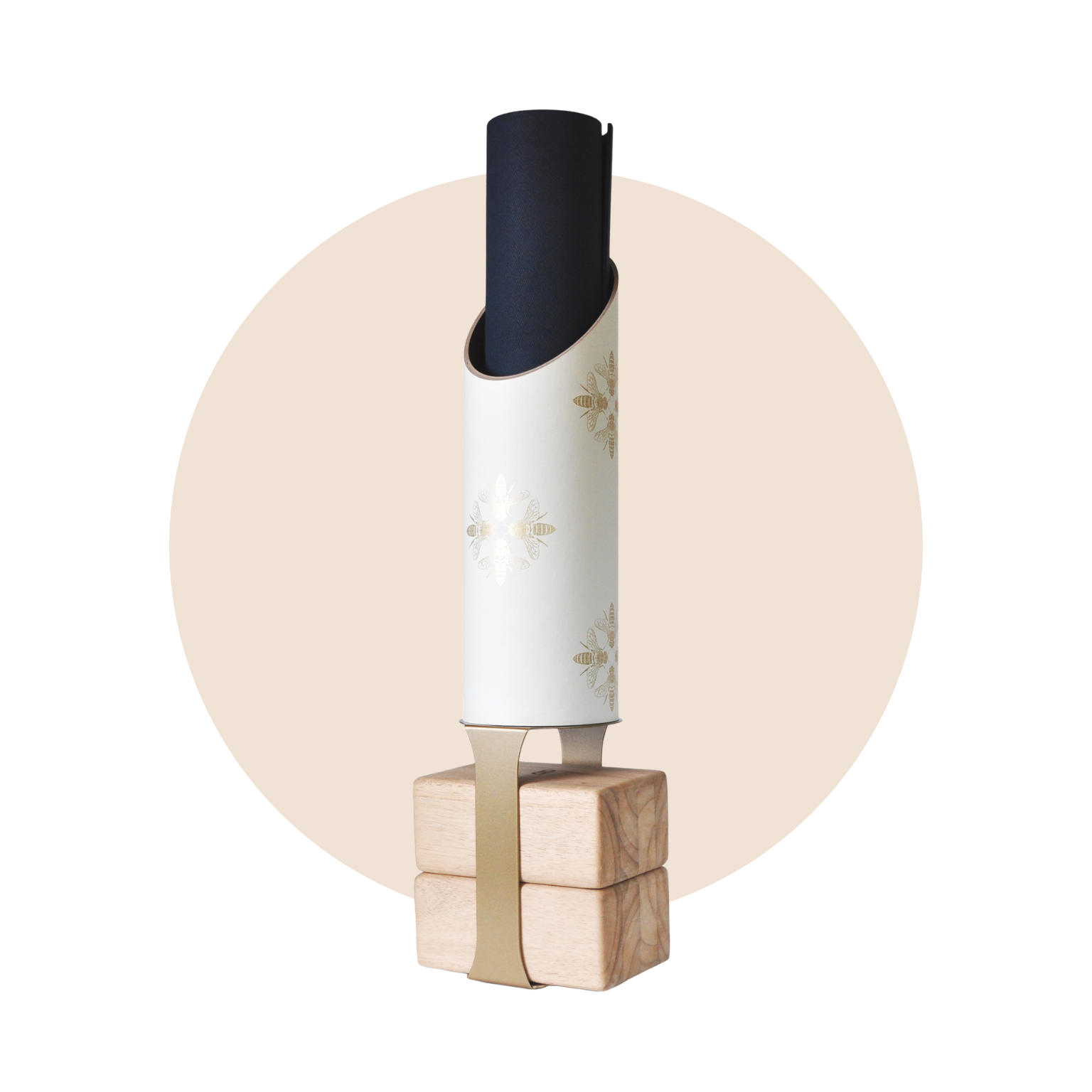
We make Mache storage because of that gap. Recycled wood pulp, natural fibers, water-based, non-toxic coatings, no Red List materials, handmade in the USA in small batches.
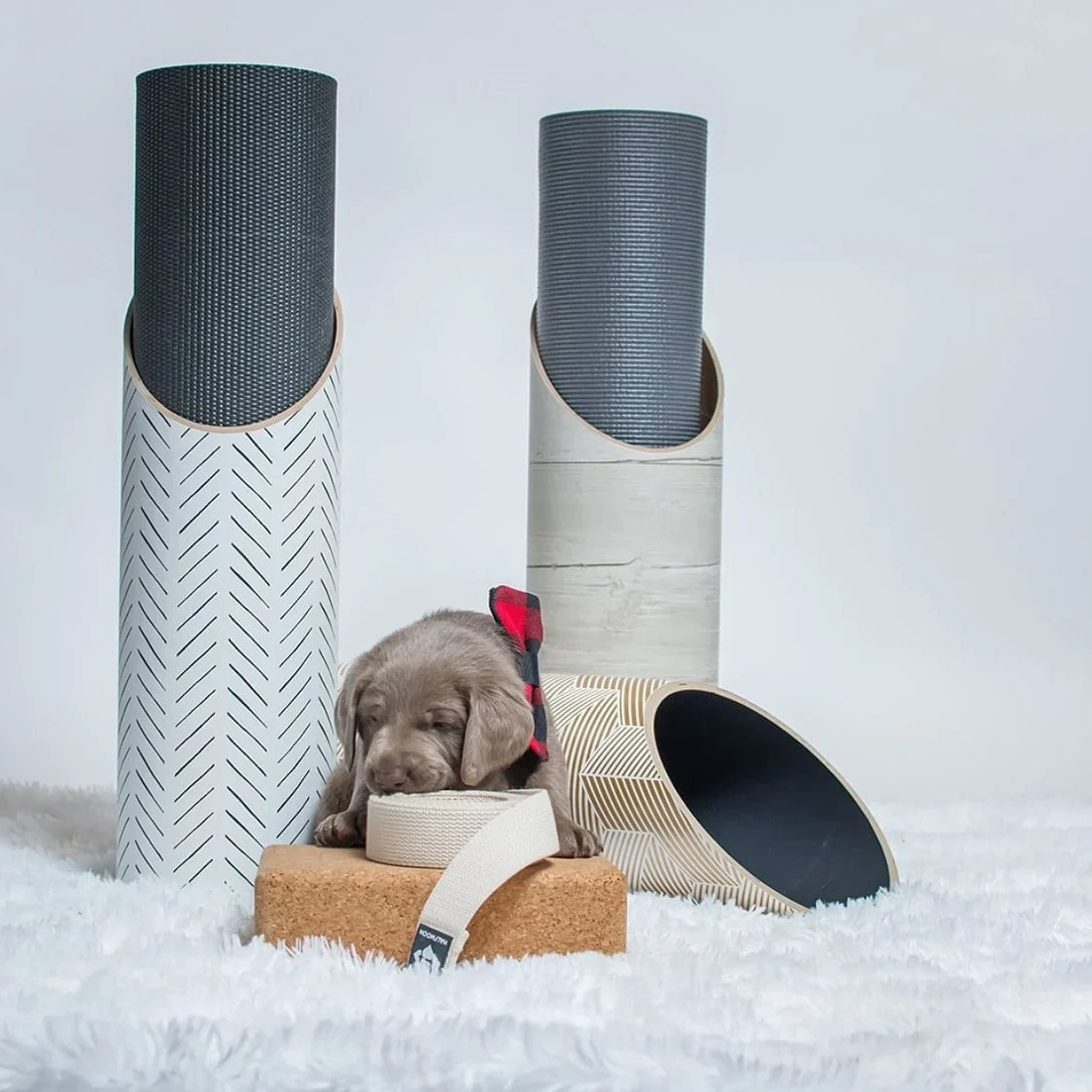
Materials are the first and most important factor at every stage of the product. Mache's tube cores use 100% recycled paper, while the end caps use 100% recycled NAF wood particle. The exterior uses renewable fiber luxury paper, and the base is made from recycled steel with a powder-coated finish for durability. Each piece is also handcrafted in small batches, keeping craftsmanship at the center of how Mache storage is made.
What to look for in any prop storage, ours or anyone's:
-
Ventilation, so a damp mat dries instead of growing something
-
Vertical or wall-mounted, so blocks and straps stop migrating
-
Visible placement, because visible is the whole mechanism
-
Materials you'd be comfortable sleeping next to
-
A footprint that fits the corner you actually have
Two Configurations That Work in Real Homes
Most people don't have a spare room. They have a corner. Here's how that corner gets solved:
|
Setup |
What it holds |
Best for |
Price |
|
|
Mat or foam roller, two blocks, a strap |
Apartments, bedroom corners, floor-standing |
From $120 |
|
Mats, rollers, and bulky bolsters |
Anyone who owns a bolster and no floor space |
$225 |
|
|
Three mats or rollers |
Couples, families, shared spaces |
$225 |
I recommend the StackRack for anyone buying a bolster.
The Complete Setup: What It Costs, Who Makes What
Two brands, complementary roles. Bean Products makes the pieces you practice with. Mache makes the storage that keeps them organized and within reach.
|
Piece |
Product |
Maker |
Price |
|
Mat |
OMphibian natural rubber, 1/4" x 26" x 72" |
Bean Products |
$79.95 |
|
Blocks (2) |
Cork, 9" x 6" x 3" |
Bean Products |
$29.99 |
|
Strap |
Hemp sling + stretching strap |
Bean Products |
$24.95 |
|
Bolster |
Organic cotton, extra-firm |
Bean Products |
$119.95 |
Props Subtotal $254.84
|
Storage |
Homi Yoga Mat Tube |
Mache |
From $120 |
Core setup total $375
|
Storage (bolster included) |
StackRack Wall Organizer |
Mache |
$225 |
Full setup total $600
Both companies are USA-based and work in small batches. Bean Products has been based in Chicago since 1987, while Mache is woman-founded and handcrafts its products in the USA. Both brands focus on materials, construction, durability, and thoughtful design.
Buying in Stages? Do It in This Order
You don't have to buy all six pieces at once. If you're building your setup gradually, start with what will support your practice now and add pieces as your needs change.
-
Mat + One Storage Piece: Start with both. Having a place for your mat from the beginning keeps it accessible without leaving it in the middle of the room.
-
Two Cork Blocks: Add these next for support and greater flexibility in your practice.
-
Hemp Strap: At $24.95, it is a relatively small addition that can make certain stretches and poses more accessible.
-
Bolster + Wall Rack: Add these when you're ready for a more supported, restorative practice and need a dedicated place for larger props.
Storage comes early because accessibility matters. When your equipment has a clear place to live, it is easier to reach before practice and put away afterward. The goal is to make your space work with your routine, not create another obstacle.
Your First Week: Four Steps to a Corner That Works

Gear is the easy part. Placement helps determine how naturally it fits into your home.
Step One: Pick the corner before the props arrive. It does not need to be a dedicated yoga room. Choose somewhere you already walk past each day, such as a bedroom, living room, or home office. A convenient location makes it easier to return to your practice.
Step Two: Mount or place your storage first. This may sound backward, but it gives your equipment a defined home before the rest of the setup arrives. Storage helps establish the space, while the props fill it.
Step Three: Give your new mat time to air out. Even natural-material products can smell of manufacturing when you first unpack them. Let it breathe in a well-ventilated area before your first session.
Step Four: Put everything away after practice. For the first couple of weeks, this may feel like another small task. Over time, it can become a simple bookend to your session.
"Putting them in and taking them out of the stand has made a sweet ritual out of beginning and ending practice." Della, on her Homi tube and stand.
If you want more ideas for creating a wellness space without a renovation, we covered it here: How to Turn Everyday Spaces Into Wellness Spaces.
Four Objections, Answered Straight

"I already own a PVC mat. Should I throw it out?"
No. If your mat is still functional, use it. Replacing something you do not need to replace creates unnecessary consumption. Store it properly for better lifetime. When your current mat reaches the end of its useful life, you can consider natural materials and other options that align with your priorities.
"$375 is a lot for yoga props."
It is a meaningful purchase, and you don't need to buy it all at once. Start with the pieces you need now, then add to the setup over time. Paying attention to materials, construction, and durability can also help you make a more considered purchase.
"I live in 500 square feet."
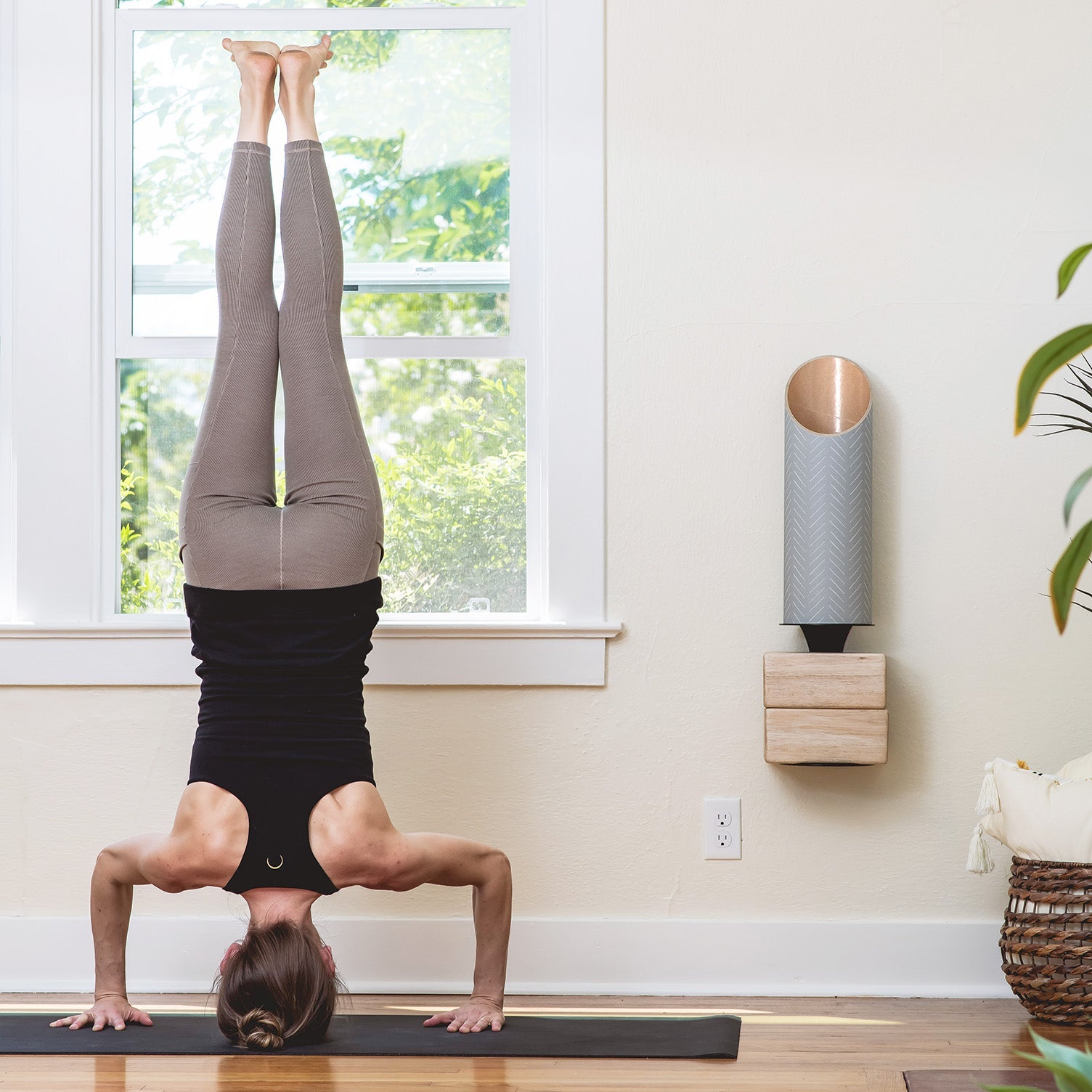
Then vertical storage may be especially useful. Wall-mounted systems can keep mats and props off the floor while using otherwise unused wall space. A compact tube can also provide dedicated storage without requiring much floor space.
"How do I know Mache storage isn't greenwashed too?"
Fair question, and it's the one this whole article opened with. At Mache, we list our materials on our sustainability page, our founder's background is public, and if something isn't answered there, ask us directly. Any brand that won't answer that question has told you the answer.
How to Build Your Sustainable Yoga Space Over Time

You do not need a fully equipped studio to create a yoga space at home. A sustainable yoga practice can start with a few well-chosen pieces and grow as your routine becomes more established. Buying gradually also gives you time to learn what you actually use instead of filling your space with props that sit untouched.
Start With the Essentials
1. Mat
Start with a mat that feels comfortable and gives you enough grip and support for the kind of practice you want. If you already own a functional mat, use it until you genuinely need a replacement.
2. Blocks
Add two blocks next. They can bring the floor closer, support you in poses, and make your practice more adaptable as your needs change.
3. Strap
A strap is a simple addition that can help with stretches and poses where your hands cannot comfortably reach each other. It takes up very little space, too.
4. Storage
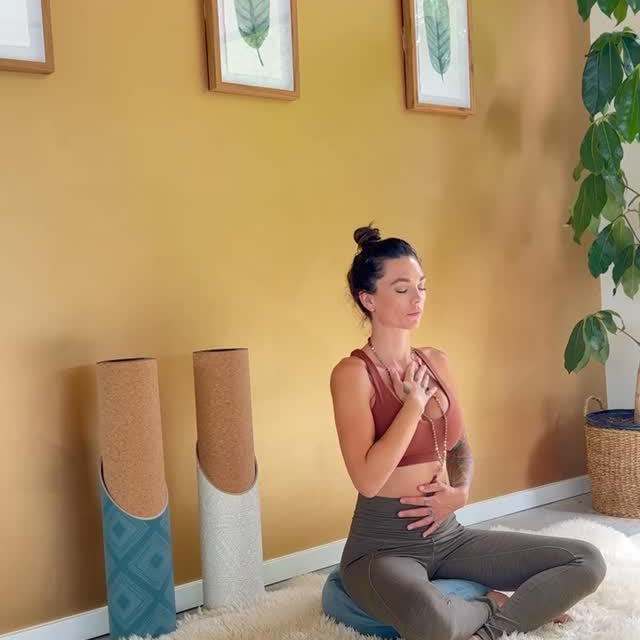
Give your gear a home early. Whether that means a floor-standing tube or wall-mounted storage, keeping your mat and props visible and accessible can make it easier to return to your practice without adding clutter to the room.
Add These Later
5. Bolster
Once you have established a regular practice, consider adding a bolster. It is particularly useful for restorative yoga, where longer, more supported positions are part of the practice.
6. Additional Props
From there, add props based on what your practice needs. You may find that you need another type of block, additional storage, or a specific prop for the classes or styles you enjoy.
The point of a sustainable yoga space is not to collect every piece of equipment. It is to build a space that supports the practice you actually have, using pieces that earn their place in your home.
FAQs
What makes a yoga practice more sustainable?
A sustainable yoga practice can start with choosing durable products, understanding the materials used to make them, caring for your equipment, and building lasting habits. It also means using what you already own for as long as it remains functional and replacing pieces when you genuinely need to.
What are the most important pieces for a home yoga setup?
A mat, two blocks, a strap, and a storage solution form a practical foundation for a home yoga space. As your practice develops, additional props such as a bolster can provide more support, particularly for restorative yoga.
Is a natural rubber yoga mat better than a synthetic mat?
The right choice depends on your practice, preferences, allergies, and material priorities. Natural rubber is valued for its grip and durability, while synthetic materials may offer different performance characteristics. Check the manufacturer's material information and choose what fits your needs.
How should I store yoga equipment at home?
Keep frequently used props clean, organized, and easy to access. Wall-mounted systems, vertical storage, and dedicated practice corners can keep equipment off the floor and make it easier to reach when you want to practice.
What makes yoga props eco-friendly?
Look for clear information about materials, responsible sourcing, durable construction, and how a product is made. Recycled or renewable materials can be part of that picture, but durability and long-term use matter, too.
Do I need to replace all my yoga equipment to create a sustainable practice?
No. A more sustainable approach can begin with caring for what you already own. Use functional equipment until it needs replacing, then consider materials, construction, durability, and your actual needs when choosing its replacement.
Create a Yoga Space You Will Want to Return To
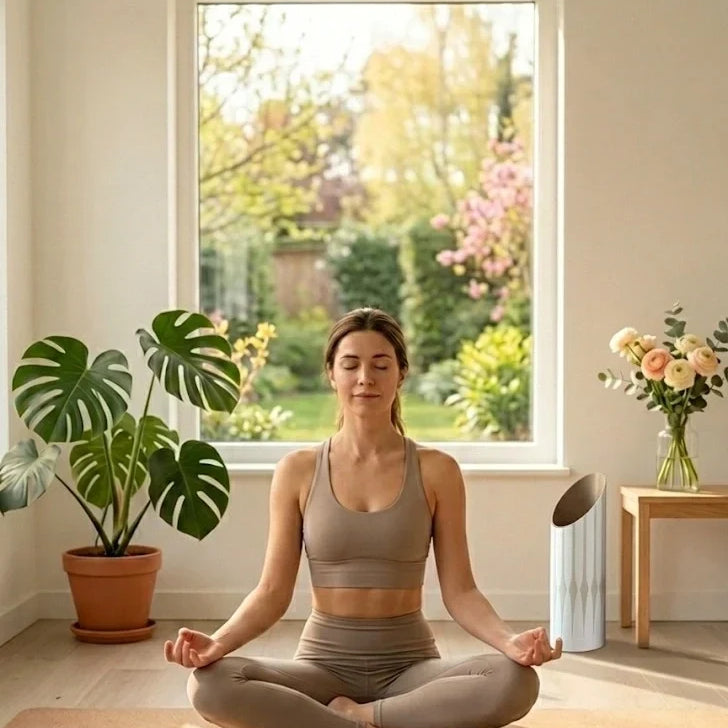
A sustainable yoga practice is built one choice at a time. The mat you use, the props that support your movement, and the way you organize your space all contribute to a practice that feels easier to maintain.
You do not need to replace everything you own or create a perfect yoga corner overnight. Start with the prop you use most, then add pieces as your practice grows.
Bean Products makes the yoga essentials you reach for most, backed by decades of experience. When something needs replacing, choose durable pieces that can stay in your practice for years.
Mache believes sustainability should be part of your practice. Thoughtful materials, purposeful design, and careful craftsmanship help your yoga gear feel at home in your space, rather than something you need to tuck away.
So, start small. Pick a corner and keep the pieces you use most within reach. Let your space evolve alongside your practice. With Mache storage, you can keep your yoga gear organized and create a space you’ll want to return to every day.
Not sure whether your home is helping or hurting your well-being? Take the Home Health Quiz. It takes just a few minutes, and it’s free.
Want a second opinion on the whole room? Book a wellness design consultation, and we’ll work through it together.
May you be well, and practice often.
Brienne Derosier
Founder + Wellness Designer, Mache
Sources
- Ecology Center Healthy Stuff Lab, Yoga Mats Testing 2019
- U.S. EPA, Volatile Organic Compounds' Impact on Indoor Air Quality
- Lally et al., via UCL: How long does it take to form a habit?
- Saxbe & Repetti (2010), No Place Like Home: Home Tours Correlate With Daily Patterns of Mood and Cortisol, Pers Soc Psychol Bull
- Wu, McIntosh & Liu (2016), Current prevalence rate of latex allergy, Journal of Occupational Health